Fees buy hashrate.Hashrate buys $LODE.
On Robinhood Chain, every $LODE trade feeds a treasury that leases Scrypt miners. They earn Litecoin and Dogecoin at once.
A mine you holdinstead of run.
Lode is a token on Robinhood Chain. Its trading fees pay for Scrypt hash power, the work that secures Litecoin and Dogecoin. You never touch a rig, a pool config, or a power bill. You hold $LODE, and the lease keeps running whether you are watching or not.
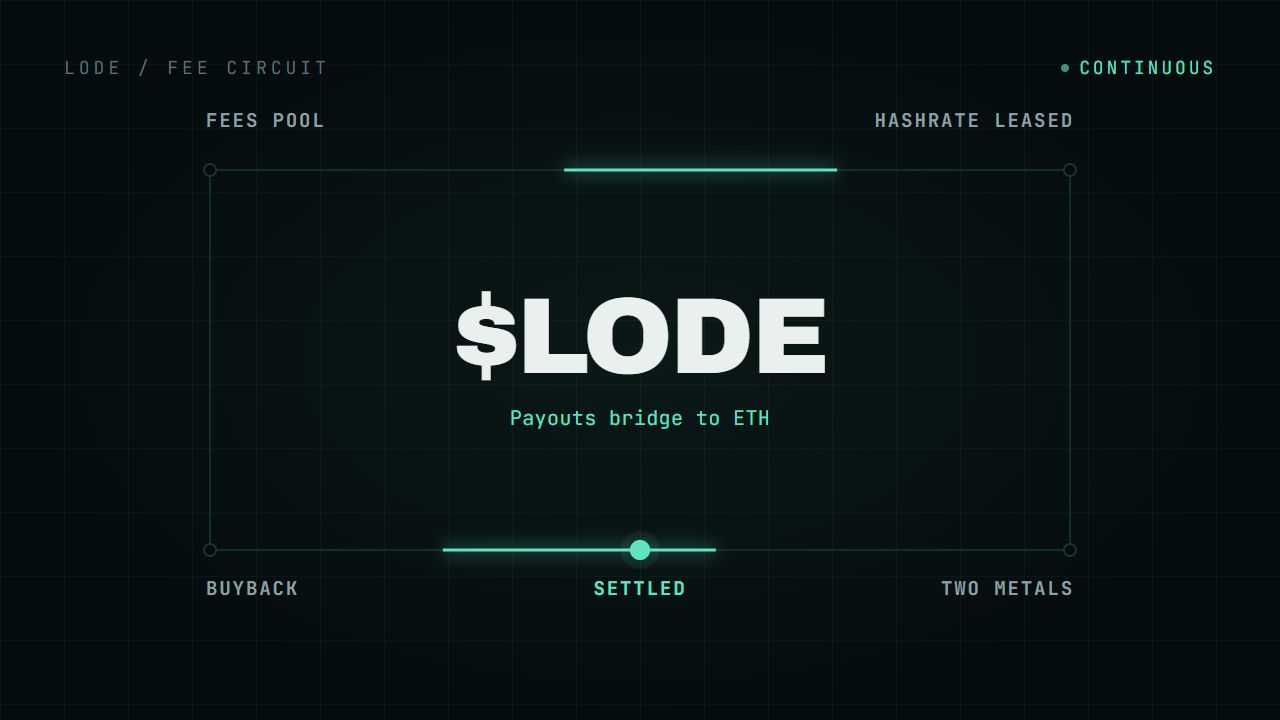
From a trade to the next buyback.
Fees pool
Every trade on Robinhood Chain routes part of its fee to the vein. Nothing is minted to pay for this.
Fees pool
Every trade on Robinhood Chain routes part of its fee to the vein. Nothing is minted to pay for this.
Hashrate leased
The vein buys Scrypt terahashes from contracted farms on fixed terms. Nobody at Lode racks hardware.
Hashrate leased
The vein buys Scrypt terahashes from contracted farms on fixed terms. Nobody at Lode racks hardware.
Two metals
That hashrate merge-mines Litecoin and Dogecoin. One submission, two chains crediting it.
Two metals
That hashrate merge-mines Litecoin and Dogecoin. One submission, two chains crediting it.
Settled
Pool payouts clear on schedule and bridge to ETH on Robinhood Chain.
Settled
Pool payouts clear on schedule and bridge to ETH on Robinhood Chain.
Buyback
The ETH market-buys $LODE. Half burns. Half seeds the reserve that keeps the lease alive through thin weeks.
Buyback
The ETH market-buys $LODE. Half burns. Half seeds the reserve that keeps the lease alive through thin weeks.
One unit of work.Two ledgers pay for it.
Dogecoin adopted Litecoin's proof of work in 2014. A Scrypt miner sends the same work to both chains and both credit it. The two readings below move together because the hardware behind them is largely the same.
Dogecoin mints ten thousand coins a minute and never halves, so it carries most of what a Scrypt lease earns. Litecoin is the chain that sets the difficulty.
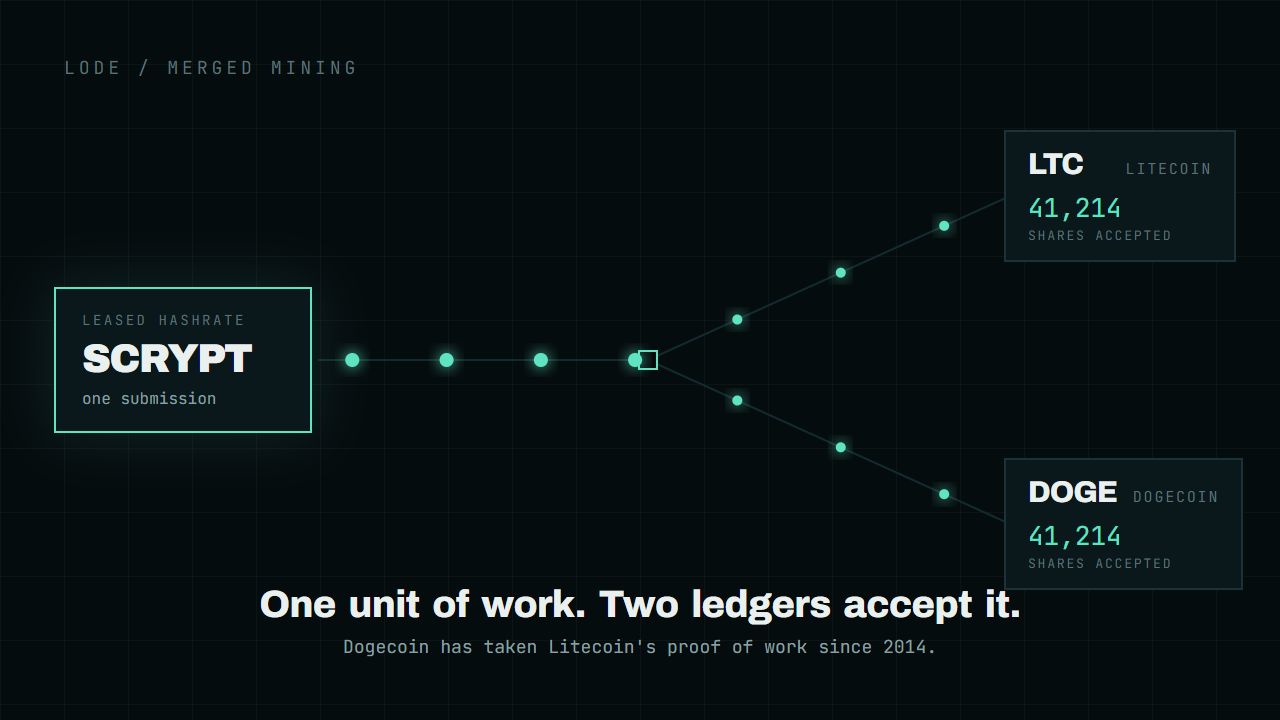
What a lease actually earns.
Move the slider. These figures come from live Litecoin and Dogecoin difficulty and price, recalculated every two minutes.
Combined
Network math only. Pool fees, luck variance, and what a farm charges for the lease sit outside it, so read every figure here as a ceiling.
Connect a wallet. Get on the register.
The register is a public count of addresses following the vein. Connecting signs a login and nothing else. No transaction, no gas, no approval on your tokens.
Straight answers.
Where is the contract address?
$LODE has not launched, so there is no token address to paste yet. It appears here, in the footer, and on X at the same moment. Anything circulating before that is not ours. The treasury and the ledger it reports into are a separate thing and they are already deployed on Robinhood Chain: the addresses sit at the bottom of the Assay.
Do I stake, claim, or run anything?
No. Holding is the whole action. There is no lockup, no claim button, no miner software.
Who actually runs the miners?
Contracted farms. Lode buys hashrate on fixed terms and never racks hardware, which is why there is no power bill or uptime story to explain away.
Why Litecoin and Dogecoin instead of one coin?
One Scrypt submission counts on both chains, so the same lease gets paid twice. Picking a single chain would throw half the revenue away.
What happens at the next Litecoin halving?
The block reward drops to 3.125 LTC at block 3,360,000, roughly 309 days out. Dogecoin keeps paying 10,000 per block and never halves, so the merged lease loses far less than a Litecoin-only miner would.
What keeps the lease running through a bad month?
The reserve. Half of every buyback stays in ETH so hashrate stays paid when the mine underperforms. The other half burns.